
One episode. One week of content. Here is the math.
A 30-minute podcast episode contains 4,000 to 6,000 spoken words. Four to six long-form articles worth of material. Inside that one recording: three counterintuitive opinions your audience has never heard stated that clearly, two frameworks others in your industry have never written down, one story that illustrates why you do what you do — told in a way only you can tell it, and four scroll-stopping hooks buried in lines you said without thinking.
You do not need to create anything. You need to extract what is already there. Here is exactly how.
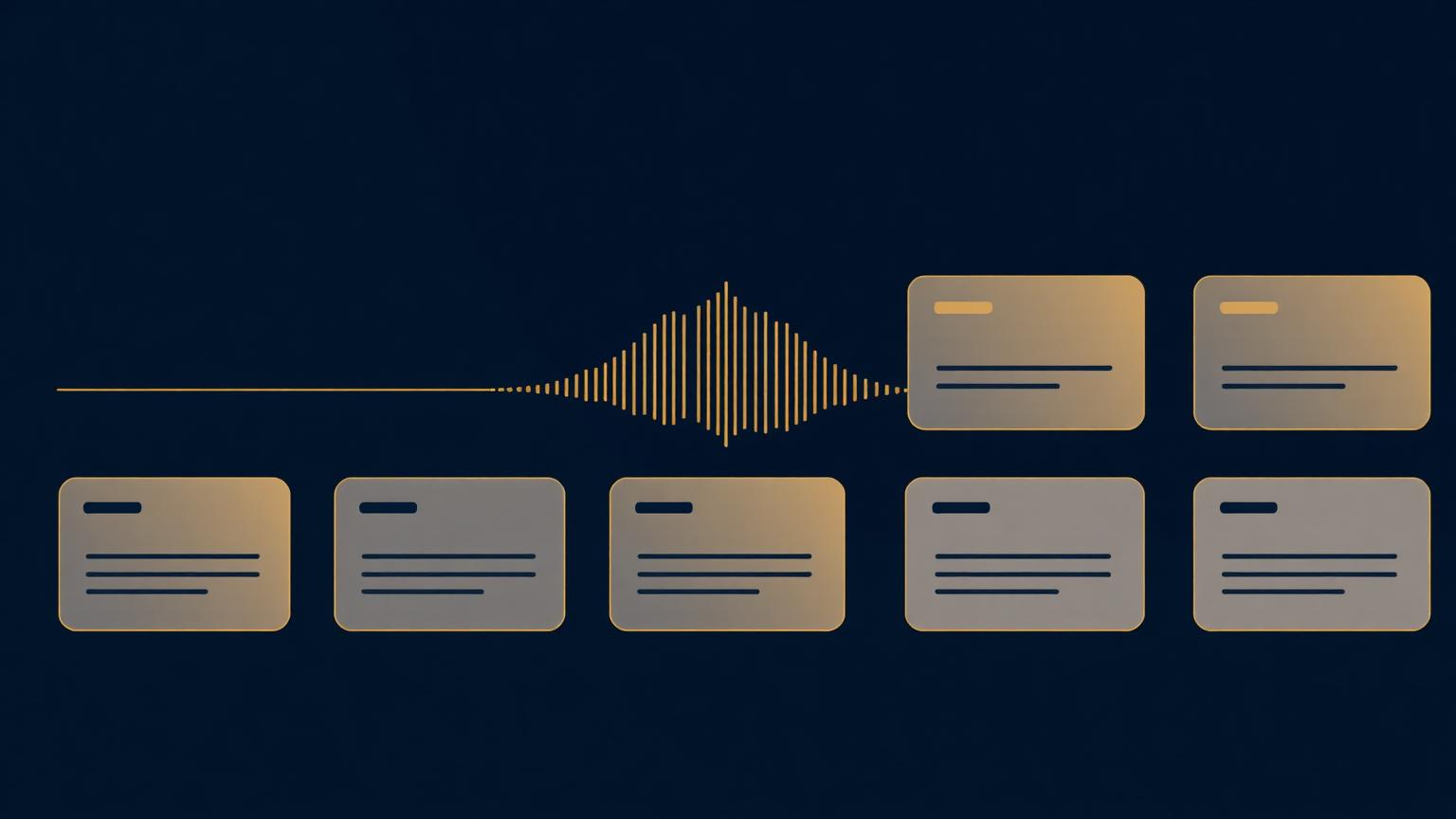
The 5-step podcast repurposing framework
Step 1: Transcribe first
Do not listen back and take notes. That is slow and you will miss what matters. Use Descript, Otter.ai, or MacWhisper and have the full transcript in under ten minutes. Everything else builds from this document.
Step 2: Hunt the authority nuggets
Read the transcript and mark the moments that made you think: I have never heard anyone say it that clearly. These are your Authority Nuggets — the specific insights, frameworks, and stories that earn attention because they are useful and unmistakably yours. Look for four types:
- The Counterintuitive Claim — a position that contradicts the consensus. Not balanced, a stance. "Most founders think they need more content. They need fewer ideas, repeated more consistently."
- The Framework — a named system your audience could apply. Give it a name. Make it ownable.
- The Specific Story — a real moment with a beginning, a complication, and a resolution. Not vague — a scene.
- The Strong Opinion — something you would defend under pressure. No hedges. No "it depends."
Find five to seven per episode. The strongest three or four become the engine for your ten posts.
Step 3: Match each nugget to a platform
- Counterintuitive Claim → X / Twitter: hook + one punchy paragraph.
- Framework → LinkedIn: hook + 5–7 paragraphs + closing question.
- Specific Story → LinkedIn: hook + narrative arc + lesson + CTA.
- Strong Opinion → X / Twitter: hook + two supporting points.
- Framework (expanded) → Email: opening story + framework + action step.
- Best Quote → Instagram: quote card + short caption + 3–5 hashtags.
One solid nugget produces two to three posts. Three nuggets and you have your full ten.

Step 4: Rewrite for each platform — not paste. Rewrite.
This is where most founders lose the gains from the first three steps. Spoken language has filler, repetition, and conversational context that works in audio and dies in text. You cannot paste a transcript into LinkedIn and expect it to read like a post. It will read like a transcript.
- LinkedIn: hook under ten words. Short paragraphs. White space is engagement. Never open with "I." End with a question.
- X / Twitter: the first line is everything. Single posts under 280 characters. Threads live or die on the opening tweet.
- Email: open with a story, not a summary. The framework comes second. One action step at the end.
- Instagram: write for the caption. The image stops the scroll — the caption builds the relationship.
Step 5: The quality pass
- Does the hook earn the scroll? Would you stop for this from a stranger in your feed?
- Does it sound like the founder? Or like a press release?
- Is there an AI-ism hiding in it? "Leverage." "Unlock." "Delve." "Game-changer." Find one, kill it.
All three pass — publish. One fails — rewrite the sentence and check again.
What one episode actually produces
- 4 LinkedIn posts — formatted for thought leadership.
- 4 X / Twitter posts — hook-driven, under 280 characters.
- 1 Email newsletter — story-led, one action step.
- 1 Instagram caption — on-brand, with hashtags.
“Ten posts. Zero new ideas. Zero hours at a blank page.”
What this looks like in practice
Sara submitted a 35-minute founder podcast episode she had promoted once — a single LinkedIn post the day it went live. We turned it into 28 days of LinkedIn content. She published daily from that one episode. In three weeks, she booked six new discovery calls — all from founders who found her in their feed, not through the podcast itself.
The episode did not change. The distribution system did.
Why most founders never do this
The framework is not complicated. Most founders reading this could execute it. The honest problem: doing it well takes two to four hours per episode. For a founder with a business to run, that is a board meeting, three client calls, or a full afternoon of product work. The math does not hold.
The founders who stay consistently visible online are not doing this themselves. They handed the extraction, the rewriting, and the formatting to a system — and kept only the fifteen minutes of editorial judgment that actually requires them.
Your next episode is already written
You do not need new ideas. You do not need more time to create. That recording sitting in your drive right now? That is your next month of content.

Written by Far Mash
Far Mash is founder of Contentreach. He helps B2B founders turn long-form thinking into a steady stream of authority-building content through voice-matched editorial systems.